
The History of New York City’s Garment District: How Fashion Built an Empire
The New York City Garment District is more than a collection of fabric stores, showrooms, and sewing studios- it’s the birthplace of American fashion. Located primarily between Fifth and Ninth Avenues and stretching from approximately 34th to 42nd Streets in Midtown Manhattan, the district has been at the heart of the United States apparel industry for well over a century.
While today it is recognized as a historic neighborhood filled with fashion wholesalers, textile suppliers, designers, and educational institutions- it’s origins tell the story of immigration, innovation, entrepreneurship, and craftsmanship that forever changed the fashion industry. Every bolt of fabric, pattern, and finished garment that emerged from the district contributed to New York City’s reputation as one of the world’s fashion capitals alongside Paris, Milan, and London.
“The New York City Garment District is more than a collection of fabric stores, showrooms, and sewing studios- it’s the birthplace of American fashion“

“Businesses gradually migrated northward to Midtown Manhattan, laying the foundation for what would become the Garment District.”
The Garment District’s roots can be traced back to the late 1800s. With the wave of European immigrants arriving in New York seeking economic opportunity, among the many- Jewish, Italian, German, and Eastern European families brought generations of tailoring, embroidery, weaving, and dressmaking skills with them. Initially, garment production was scattered throughout Lower Manhattan, particularly in crowded tenement buildings on the Lower East Side where families often worked from their homes. Smaller workshops produced shirts, dresses, coats, and uniforms under difficult conditions, with long hours and minimal safety regulations. As demand grew for ready-made clothing across the country, manufacturers needed larger spaces with better transportation access. Businesses gradually migrated northward to Midtown Manhattan, laying the foundation for what would become the Garment District.
By the early 1900s, the Garment District had become the center of America’s booming apparel industry. Technological advances such as electric sewing machines, improved cutting equipment, and standardized sizing allowed manufacturers to produce clothing faster and more efficiently than ever before. The district became an interconnected ecosystem where designers, textile importers, pattern makers, sample makers, button suppliers, trim manufacturers, pressers, and production factories operated within walking distance of one another. A designer could sketch a garment in the morning, source fabric by midday, create a sample in the afternoon, and begin production shortly afterward. This remarkable concentration of specialized businesses accelerated innovation and made New York the country’s premier destination for fashion manufacturing.
“A community of talent whose work helped shape one of the most influential industries in the world.”
Throughout the mid-20th century, the Garment District entered its golden age. During the 1940s, 1950s, and 1960s, more than a million people worked within New York’s garment industry, and thousands of factories operated throughout the neighborhood. With department stores relying heavily on garments manufactured in the district, while emerging designers found opportunities to establish their brands close to suppliers and manufacturers (best for connivance and collaboration). Seventh Avenue became known as “Fashion Avenue,” symbolizing New York’s growing influence on global style. The district attracted legendary designers, buyers, editors, and fashion entrepreneurs who collectively shaped trends seen across the country. During this period, the district represented not only manufacturing excellence but also the American dream, where skilled workers could build successful businesses through dedication and craftsmanship.
Beginning in the 1970s and accelerating through the 1980s and 1990s, globalization dramatically transformed the Garment District. Advancements came in this decade, for international shipping and lower overseas manufacturing, costs encouraged many apparel companies to move production abroad. Factories that had operated in Manhattan for decades gradually closed, and employment declined significantly. Despite these challenges, the neighborhood adapted by shifting its focus toward fashion design, product development, wholesale showrooms, textile distribution, and sample production. Rather than disappearing, the district evolved into a creative hub where designers could still develop collections, source premium fabrics, and collaborate with highly skilled artisans capable of producing prototypes and limited-run garments with exceptional quality.
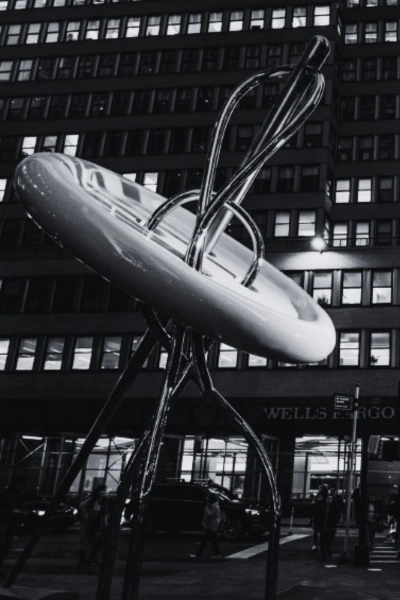
Today, the Garment District continues to play an essential role in New York City’s fashion ecosystem, even as the industry has become increasingly global. Institutions such as the Fashion Institute of Technology (FIT), nearby design studios, independent pattern makers, and specialty fabric retailers help preserve the district’s rich heritage while supporting the next generation of future designers. Visitors can explore countless fabric stores offering everything from luxury silks and bridal lace to quilting cottons, upholstery fabrics, leather, trims, notions, and sewing supplies. Public art installations, including the famous oversized button-and-needle sculpture and the illuminated “Fashion Walk of Fame,” celebrate the neighborhood’s enduring legacy. The district remains a destination where creativity, craftsmanship, and entrepreneurship intersect, attracting professionals and hobbyists from around the world.
The history of New York City’s Garment District is ultimately a story of resilience. It reflects the determination of immigrants pursuing opportunity, entrepreneurs building thriving businesses, and designers transforming ideas into wearable art. Although the scale of manufacturing has changed, the district’s influence can still be seen in fashion schools, independent brands, Broadway costume production, luxury sample rooms, and the countless fabric stores that continue to inspire makers of every skill level. For anyone passionate about sewing, quilting, design, or fashion history, the Garment District stands as a living reminder that behind every finished garment is a community of talent whose work helped shape one of the most influential industries in the world.
Let us lend you a hand on selecting your next materials!

Written by Gray Line Linen
Related Articles
Related
How to Care for Linen Fabric: A Complete Guide to Keeping Linen Beautiful
Linen is one of the most timeless and refined fabrics that you can own. Known for its natural texture, breathability, and durability, 100% linen offers an effortless balance of luxury and comfort. Whether you’re working with garments, home textiles, or custom designs,...